Base Flow Index of Way Seputih River at Buyut Udik
Abstract
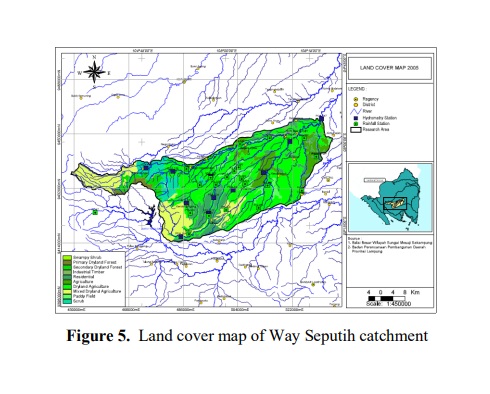
One of river flow components considered in watershed management is baseflow, the main contributor to the river flow during dry season. Ratio between baseflow to total flow is called Base Flow Index (BFI). In fact, BFI can be used as an indicator how good the catchment hydrology is. The purpose of this study is to analyze BFI of Way Seputih river at Buyut Udik Hydrometry Station. The method includes Recursive Digital Filter (RDF) method, which utilizes constant recession of hydrographs in displaying the ratio of baseflow from continuous discharge during periods when there is no direct runoff. Daily discharge data from Way Seputih river at Buyut Udik recorded from 1973 to 2006 is used. The result shows that yearly BFI values range from 0.142 to 0.487 and there is a decrease trend of yearly BFI over time. This result is confirmed by yearly average discharges which tend to decrease over time. These are affected by land cover degradation in Way Seputih catchment and this should be a concern for authorities to improve land and water conservation in Way Seputih catchment so that river flow could be maintained throughout the year
Downloads